
- Product name
- Proctorwrap®
- Applications
- Walls
- Frame type
- Timber / wood
- Steel
- Accreditation
- BBA certified
- Vapour resistance
- Sd 0.02m
- Roll dimensions
- 1.35m (grey only), 2.7 x 100m
- Roll weight
- 100g/m2
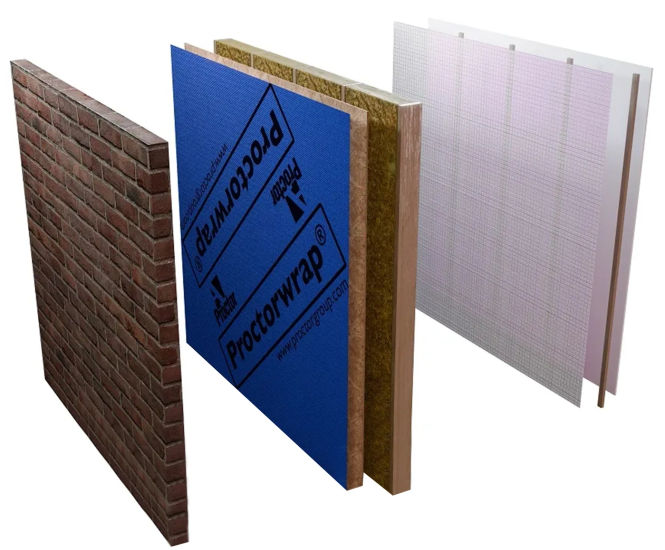
Proctorwrap is a spunbonded polypropylene film laminate material developed primarily as a breather membrane for timber frame wall and light steel frame applications.
Applied in the factory during manufacture or on site, Proctorwrap affords effective protection of timber frames during construction against wind-driven rain, snow and dust. Once completed, its high water vapour permeability allows the controlled escape of vapour from within the timber frame whilst restricting the ingress of rain and moisture.
Proctorwrap's vapour resistance of Sd 0.02m is less than the maximum permitted in NHBC requirements. Used in accordance with this NHBC Practice Note, it provides a good-quality permanent wall breather membrane.
Proctorwrap is suitable for use in exposed areas such as coastal areas due to its increased W1 resistance. This allows the use of Proctowrap in walls in all areas of the UK.
Features
Increased airtightness over traditional breather membranes
Allows temporary protection until primary external covering is installed / applied
Provides durability and reduced risk of tears and subsequent remedial work
W1 water penetration
Airtight and vapour-permeable
Specification
Thickness 0.4mm
Roll size: 1.35m (grey only), 2.7 x 100m
Material: 3-layer polypropylene film laminate
Colour: grey, blue (not all available in all sizes)
Certification: BBA certificate no. 24/7181
Technical properties
Mass per unit area: to be no less than 100g/m2
Vapour resistance: to be no more than 0.1 MNs/g when tested to BS 3177
Water vapour resistance: to be no worse than Sd 0.02m when tested to EN 12572
Tensile strength: to be no less than MD 240N; CD 125N when tested to EN 12311-1
Tear resistance: to be no less than MD 100N; CD 120N when tested to EN12310-1
Elongation: to be no more than MD 60%; CD 70% when tested to EN 12311-1
Reaction to fire: to be no worse than Class E when tested to EN 11925-2
Resistance to water penetration: to be no less than W1 when tested to EN 1928