


- Year completed
- 2025
- Client
- Tailored Lifestyle Group
- Contractor
- JPSE (John Plummer Sustainable Engineering) Construction Ltd
- Products used
- Wraptite®
Overview
A Proctor Group's Wraptite® air and vapour control membrane was used for an MMC build system on a derelict former pub site on Whitchurch Road, Telford.
Context
John Plummer Sustainable Engineering Construction Ltd (JPSE) took just 8 weeks to erect its light-gauge steel frame system on the site. Working on behalf of Tailored Lifestyle Group, the work included fitting cement particle sheathing boards and applying Wraptite® membrane.
Thanks to Wraptite’s proven performance characteristics, the entire structure had its airtightness line in place, and enjoyed temporary weather protection, less than two months after the screw pile foundations and ground beams were first installed – a testament to the benefits that modern methods of construction (MMC) can offer.
Making a constrained site work while lowering carbon
As well as employing MMC to best effect, Tailored Lifestyle Group integrates low carbon principles on every scheme it develops – including reduced concrete use and fabric first design. The lightweight steel frame is central to that approach. Not only does it impose lower loads onto the screw pile foundations, but it also makes constrained sites more viable.
The brownfield site at Whitchurch Road had been subject of numerous failed redevelopment attempts. Despite a constrained site, Tailored Lifestyle Group was able to arrange just in time deliveries of the steel frame components, all offloaded without the use of a crane.
“There is no ‘one size fits all’ solution in construction,” said Kieran Danby, co-founder of Tailored Lifestyle Group. “We called ourselves ‘tailored’ because we believe in adopting the right approach for our client and the site. At Whitchurch Road, the light gauge steel frame was a perfect solution. There would have been so much more risk had we adopted a different solution.”
How the Wraptite membrane supported the MMC build system
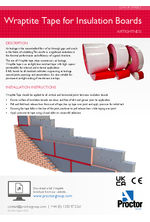
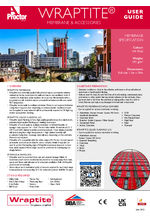
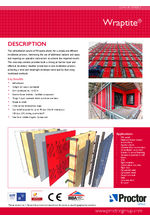
As a self-adhered membrane, Proctor Group’s Wraptite provides a consistent airtight seal without the need for additional primers or adhesives. It places the building’s airtightness line on the external face of the structure, away from the ‘services zone’ at the internal face. Continuing the Wraptite from the walls to the roof further reduces thermal bridging and delivers a better standard of airtightness.
“Installing Wraptite externally is the first point you can make a building airtight. Everything inside the line is then airtight, so it doesn’t matter what internal work you do,” said Kieran. “The membrane gives you a clear definition – you don’t have to query where the airtightness line is. That it goes over the roof too is great, because eaves details are one of the hardest points to get right. And if anything does penetrate the Wraptite layer itself, you know why and you can manage it.”
At the same time as providing a high level of airtightness, Wraptite is also vapour-permeable. Allowing moisture vapour to pass through the structure eliminates any potential for condensation risk within the wall or roof build-up. With a W1 resistance to water penetration classification when tested to EN 13859-1, Wraptite can typically be left exposed for up to 120 days in the UK climate. At Whitchurch Road, making parts of the building weathertight and airtight with Wraptite meant interior works could start while the sheathing and membrane was still being installed on another part of the site.
That simply wouldn’t have been possible had they chosen an alternative structural system, and the build programme would have been longer.
“We had some short, sharp, heavy showers during the few weeks that JPSE Construction were on site,” added Kieran. “It’s no exaggeration to say the project wouldn’t be where it is now without Wraptite".
Achieving maximum performance from a ‘minimum’ standard
The Building Regulations in England are sometimes criticised – including by Proctor Group – for being ‘only’ a minimum standard. Wraptite is a Passivhaus-certified component, and its status as a high-quality product suitable for use in Passivhaus buildings sees it used on many such projects.
At Whitchurch Road, Tailored Lifestyle Group had no ambitions to achieve a voluntary standard that exceeds the ‘minimum’ required by the Regulations. And yet, by taking the route it did, the eventual occupants of the purpose-built supported housing will benefit from an EPC rating of A.
“The airtightness performance has certainly contributed to that result from the compliance calculations”, said Kieran.
Tailored Lifestyle Group’s priority was to design a project that could be built quickly on a constrained site, with minimum disruption to the area, while abiding to its low carbon principles. With the aid of Wraptite, it will also deliver housing that is energy efficient and comfortable for its occupants.