
- Product name
- Proctorwrap Reflect®
- Applications
- Walls
- Frame type
- Timber / wood
- Steel
- Features
- Perforated
- Vapour resistance
- Class W2
- Roll dimensions
- 1.5 x 50m
- 2.7 x 100m
- 3 x 100m
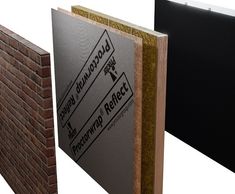
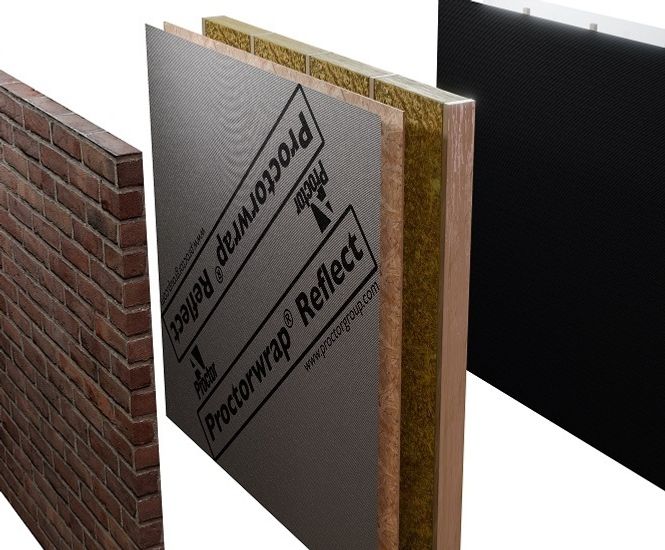
Proctorwrap Reflect® is a vapour-permeable, low-emissivity membrane specifically designed to enhance the thermal performance of timber and steel frame structures.
This non-woven polypropylene foil laminate provides excellent breathability, as well as secondary protection to the building during construction. It is installed on the external face of the timber frame, foil side face out, similar to that of a traditional breather membrane but with added thermal benefits.
Proctorwrap Reflect complies with the vapour resistance requirements set out by TRADA and the NHBC. The existing legislation requires a breather membrane to have a vapour resistance not greater than Sd 0.12m / 0.6 MNs/g; Proctorwrap Reflect has a vapour resistance of Sd 0.08m / 0.4 MNs/g.
The A. Proctor Group can provide a range of solutions, with U-values, down to as low as 0.18W/m2 K in standard timber frame walling applications.
Once Proctorwrap Reflect is applied to the walls, the primary wall covering should be installed within 3 months.
Proctorwrap Reflect must be covered as soon as practically possible on completion of installation. Any damaged areas should be repaired or replaced before completion.
Features
R value 0.665
Competitively priced
Enhanced foil surface
Low vapour resistance - complies with TRADA and NHBC requirements
Water resistant
High strength to weight ratio
Improved thermal resistance
1.5, 2.7 and 3m-wide rolls
Specifications
Thickness: 0.55mm
Roll size 1.5 x 50, 2.7 x 100 or 3 x 100m
Material: polypropylene spunbond and microperforated aluminium foil laminate
Technical properties
Mass per unit area: to be no less than 140g/m²
Water vapour resistance: to be no greater than Sd = 0.08m when tested to EN12572
Reaction to fire: Class E or better when tested to EN 13501-1
Water penetration: to be no less than Class W2, aged and unaged, when tested to EN 13111:2010
Tensile strength: to be no less than MD 180 N; CD 160 N when tested to EN 12311-1
Tear resistance: to be no less than MD 200 N; CD 200 N when tested to EN 12310-1
Elongation: to be no less than MD 70%; CD 60% when tested to EN 12311-1
Emissivity: to be no worse than 0.05 to EN 15976