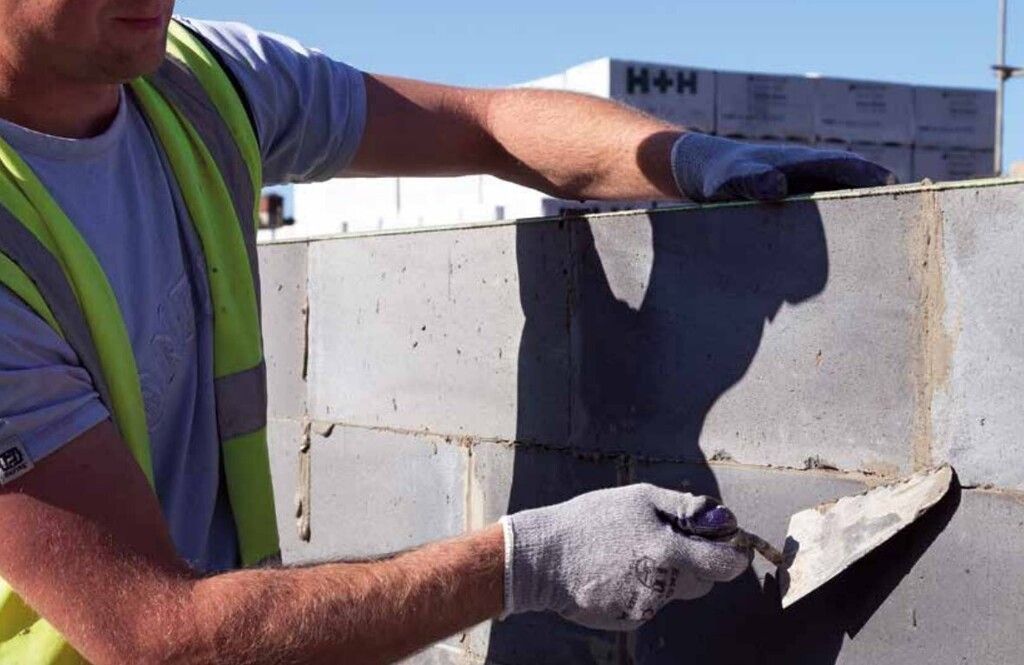
Thin-Joint construction combines the use of large format, accurately dimensioned aircrete blocks and quick setting mortar to create a highly productive and cost-effective building system.
Thin Joint Construction with Aircrete Blocks
The system promotes the use of much larger blocks with 2mm joints, rather than the traditional 10mm joints and can be used for solid or cavity walls in all types of buildings, be it houses, apartments, commercial buildings, schools or offices.
The Benefits of Thin-Joint
The Thin-Joint System, recognised as a modern method of construction (MMC), is an established build system in the UK construction industry which responds directly to Government initiatives for speeding up the supply of housing, whilst improving the quality of build and reducing its environmental impact. It allows construction times equivalent to an off site manufactured solution without the restrictive long lead-in times. The system retains the flexibility of design that a traditional build enjoys, allowing adaptations on site for any issues that may have been overlooked at the design stage. It also simplifies any changes that are made to the building at a later date, such as extensions, conversions or conservatories.
Since air-tightness is now an integral part of achieving Building Regulation compliance, it has become an important factor in the design and construction of any building. Preventing warm air from escaping through uncontrolled ventilation and air leakage is a key component in controlling heat loss through the fabric of a building. Tests undertaken by Building Services Research and Information Association (BSRIA) have shown that H+H aircrete achieved an air permeability of 0.12m3/ hr/m2 measured at 50 pascals. Using H+H aircrete can therefore make a significant contribution to achieving low Design Air Permeability rates now commonly required for dwellings under Part L of the Building Regulations. Although aircrete itself is virtually airtight (when Thin-Jointed with fully filled joints without finish, gives an air tightness performance of around 1m3/hr/m2), the overall air leakage of a building is very much dependent on the external fabric performance as a whole. It relies on good workmanship and detailing at junctions and service penetrations. Values of less than 5m3/hr/m2 have been regularly achieved.
H+H’s Thin-Joint System has some positive speed and quality benefits:
Speed
- Reduces the quantity of mortar used by approximately 80%
- Fast setting mortar allows continuous laying to storey height
- Ease of mixing and application of mortar
- Early installation of floors and roofs
- Early installation of internal block walls in frame buildings – not reliant on weather-tight shell
- Very quickly provides solid robust walls
- Post fixing of cavity ties, enables outer leaf to be taken off critical path planning
- Simplicity of installing insulation
- Much less dependent on weather,
- Celfix can be laid at 0ºC and rising
- Joints are not washed out by sudden rain
Quality
- 2mm joints and larger units reduces Thermal Bridging
- Reduction of site wastage
- Improved air tightness
- Improved build accuracy of finished walls
- Easy to extend or adapt during or after construction
- Allows the use of thin coat finishes (e.g. spray plasters)
- Fixing location not reliant on stud work centres
- Allows retrofitted joist hangers, improving air tightness & sound control