

- Sector
- Housing, private
- Project type
- New build
- Project location
- South East England
- Contract value (£)
- 439,000
- Client
- A2Dominion
- Consultant
- Calfordseaden
- Contractor
- Minett Group
- Products used
- Jumbo Blok
Context
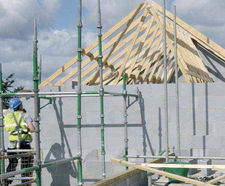
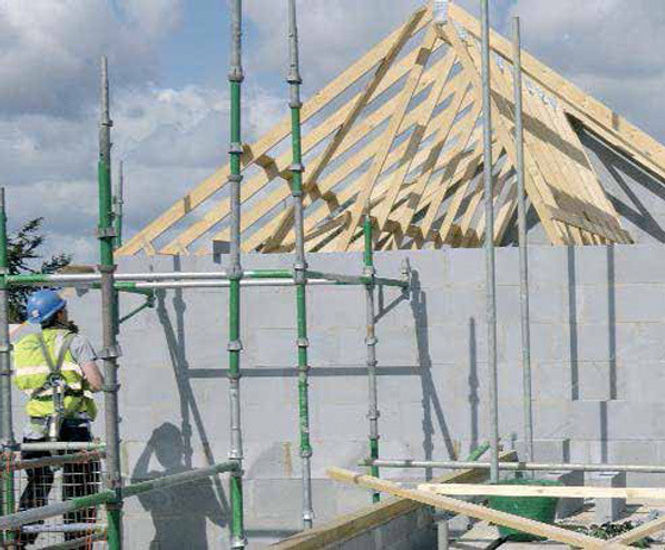
This housing development project in Oxfordshire saw the creation of 28 new affordable houses and one three-storey block of flats. The development made use of the Rå Build method of construction throughout. This involved building the entire inner skin of a building including inner leaf, internal and separating walls using H+H aircrete blocks.
Products used
- For the 22 houses: 3.6N/mm2 Jumbo Bloks 610 x 270 x 100mm thick
- For the apartments: 7.3 N/mm2 Jumbo Bloks 610 x 270 x 147mm thick
Build time
With the scheme split between individual houses and an apartment block, build time varied. Approximately 10 weeks were taken to complete the aircrete element of the apartment block. 16 weeks were taken to complete the houses. In total, some 5200m2 of aircrete was laid.
Walls
The twin-skin internal and external walls use the same 100mm-thickness of H+H’s 3.6N/mm2 Jumbo Bloks. Rockwool insulation fills the 100mm cavities. For the apartment block’s outer walls, the higher 7.3N/mm2 specification Jumbo Bloks were applied to take the load of the extra storey. The interiors were lined with plasterboard on dabs. This specification has been predicted to achieve air loss levels of between 4 and 5m3 per hour, a U-value of 0.27W/m2 K and therefore help to meet level 3 of the Code for Sustainable Homes.
Floors
The Rå Build method enabled Wates Living Space to cost the project with a saving of £20,000 less than using a timber-frame approach. Rå Build created the exterior walls, upper floors and partitions as a labour-inclusive package supplied by the Minett Group, without any of the logistical problems associated with co-ordinating different trades for each stage. The first-fix trades could start work inside whilst the external skin went up - therefore saving valuable time and money. Unlike most frame systems, the Rå Build method required no waiting time for settlement before the mostly face-brick finishes and either render or Eternit composite weatherboard were applied. The use of large-format lightweight aircrete and quick-setting thin-layer Celfix mortar enabled full-storey heights to be built in a day.