

- Sector
- Community and amenity
- Project type
- New build
- Services provided
- Planning advice
- Design
- Year completed
- 2008
- Project location
- London
- Contract value (£)
- 6.4m (total project)
- Client
- City & Hackney Teaching Primary Care Trust
- Consultant
- Aedas AHR Architects
- Contractor
- Balfour Beatty, Flahive Brickwork (bricklaying subcontractor)
- Products used
- H+H Celcon Pluis Blocks with the Thin-Joint system
Challenge
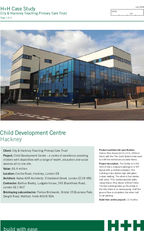
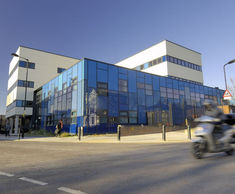
The new Children and Young Person's Centre for Development and Disability (Hackney Ark) is a centre of excellence providing children with disabilities with a range of health, education and social services all on one site.
The building takes the form of two L-shaped buildings in a 69 layout with a central courtyard.
The original specification for the building was to be dense block externally with a render finish. Internal lining was to have been a light gauge steel frame system with a dry-lined, plasterboard finish.
However, while the light gauge steel frame is quick to erect, lead times are lengthy and overall construction time would have been slow, due to the time required to build the dense block wall for the outer leaf.
Solution
One building is constructed two-storeys high with glass curtain walling, while the other is four storeys with solid, thin-jointed aircrete walls using 200mm-thick Celcon Plus aircrete blocks, to infill the reinforced concrete frame. The solid wall was finished with insulated render on the exterior and dry-lined on the inside.
This was the first major project Balfour Beatty had used the Thin-Joint System on. H+H sales and technical staff attended two design meetings with the architect and project manager to help with the development of the design using Thin-Joint technology.
H+H produced U-value calculations and advised on acoustic solutions. Detailed advice was given on the use of bed joint reinforcement which both reduced the amount of reinforcement being used and enabled the number of windposts used to be reduced.
Balfour Beatty was also trialing a waste management programme on site using the WRAP Waste Reduction Scheme. H+H provided advice on waste minimisation and the recycling of aircrete block off cuts.
Outcome
The H+H Celcon Block system was chosen over a light gauge steel frame system by Balfour Beatty because it offered benefits with the ease of construction and the speed of construction, as well as significant cost savings.
The solid wall solution negated the need for the Metsec frame and Thin-Joint technology, using quick-setting Celfix mortar, ensured that the wall was built in much quicker time than the dense aggregate wall with conventional mortar.
Masonry blockwork was also more flexible in use than the light gauge steel frame system.
“It’s a very good system and we will certainly be using it again. Overall, we reckon that using aircrete blockwork saved us something between £60,000 and £80,000 compared to a Metsec frame system and including the savings from fewer wind posts and bed reinforcement joints. The reduced amount of waste using aircrete and being able to recycle it is also a major benefit, especially for public sector projects.” – Steve Penwill, Project Manager, Balfour Beatty.