

- Sector
- Housing, social
- Project type
- New build
- Project location
- South East England
- Contract value (£)
- £750k for all masonry Rå Build work
- Client
- Ashford Borough Council
- Contractor
- Principal contractor: ISG Jackson; specialist contractor: Masonry Frame Systems
- Products used
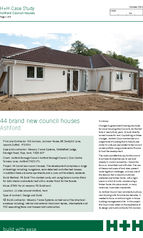
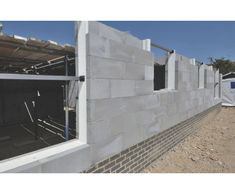
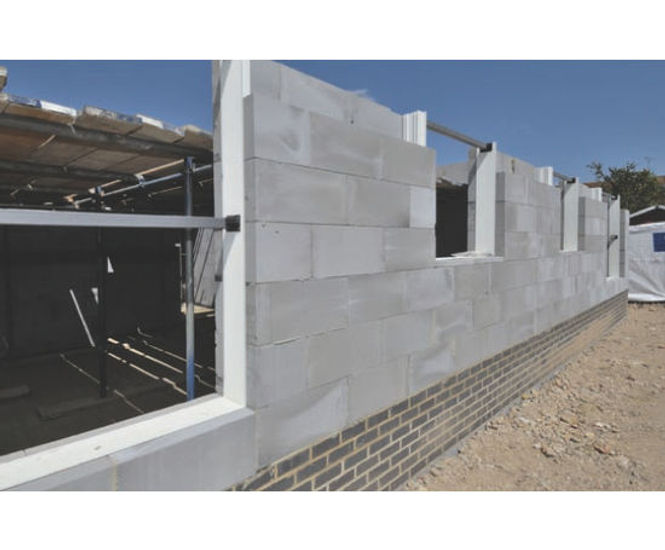
- Rå Build Thin-Jointed cavity wall, using Celcon Jumbo Bloks for both interior and exterior leaf, with a render finish for the facade
Challenge
Changes to government funding structures for social housing allow Councils, for the first time in nearly thirty years, to build directly-owned houses for rent. Capitalising on these changes, Ashford Council embarked on a programme of building that is likely to see some 20 units per year added to the Council-owned portfolio, using private sector finance to fund the development.
The most cost-effective way for the Council to achieve its objective was to use land already in Council ownership – hence the focus on brownfield and infill sites. The use of these small areas of land does present some logistical challenges, and was one of the reasons that a masonry build was preferred over timber frame; with a tight space in which to build, manoeuvring a timber frame into place would, in many instances, have been impossible.
As Ashford Council had not directly built any new housing units for some two decades, it needed to focus on enhancing its in-house building-management skills. In this project the Council also relied on the experience of its design and build contractor, ISG Jackson.
Solution
The dwellings were all built to Code Level 4 of the Code for Sustainable Homes. Although in advance of the existing building regulations, this objective fitted with the government’s aim of encouraging government agencies to increase standards of sustainability. To achieve this rating, the construction elements needed a high level of thermal insulation. The Rå Build method using the H+H Thin Joint masonry system was specified using Jumbo Bloks. Fully filled cavities were combined with either aircrete or brick outer leaves.
This is not only an extremely fast and efficient method of building, but also provides substantial benefits in reducing heat loss. In designing the wall structure, the use of aircrete’s very low psi values, based on Accredited Construction Details, allowed a halving of the y-value from 0.08 to 0.04 W/m2K. This is used to calculate the impact of linear thermal bridging within SAP 2005.
The 0.04 y-value is achieved by virtue of the thermal efficiency of aircrete, without the need to resort to Enhanced Construction Details, and has a similar effect on all external elements. Wherever possible, the contractors used aircrete for both leaves of the external walls in order to fully capitalise on the inherent thermal efficiency of aircrete. The outer leaf was then finished with a through-colour monocouche render.
High performance full-fill cavity wall insulation manufactured by Superglass was used in the 125mm cavity. The structural width of the whole cavity wall was no more than 325mm, with a U-value of 0.19W/m2K using two Thin Jointed leaves of 3.6N/mm2 aircrete. However, taking into account the 0.04 reduction in the y-value meant that the walls effectively provided a U-value of 0.15W/m2K.
Outcome
To complete the energy efficiency of the build, solar PV panels were used on the roof of the dwellings. It was necessary to include some renewables in this project to achieve Code 4 level, but the contractors did note that the very thermally efficient structure significantly reduced the PV requirement.
“On this development we wanted to build to Code Level 4. Although in advance of current building regulations, the government is looking for agencies to increase sustainability standards so we were looking for an effective way to build to this level. We wanted to go with an all masonry solution for several reasons. We wanted a really robust solution to help with our longer-term planned maintenance programme and feel that masonry provides us with the reassurance of a really solid structure. We also considered that air-tightness that the Rå Build method offers, particularly the assurance that this level of air-tightness will be maintained over time. The masonry solution also gave us the flexibility to include bespoke designs – which is key to the success of this project, given the nature of the sites we were developing.”
Giles Holloway, Ashford Borough Council
“We are Rå Build contractors so this is all we do, but for this project the masonry block design was ideal. All the sites are infill so space for access was limited – the blocks could easily be delivered in small loads with no requirement to use cranes for unloading. Each building is also a bespoke design, so the inherent flexibility of a block- based structure is a key advantage – the nature of blockwork is that you can hand build it to any required design.”
Norman Hinckes, Director, Masonry Frame Systems