

- System suitability
- External walls
- Rainscreens
- Materials
- Concrete
- Glass
- Features
- Secret fixed
- Ventilated
- Thickness (mm)
- 15-20mm nominal
- Dimensions (mm)
- single skin panels up to 3.5m2 stud frame panels up to 10m2
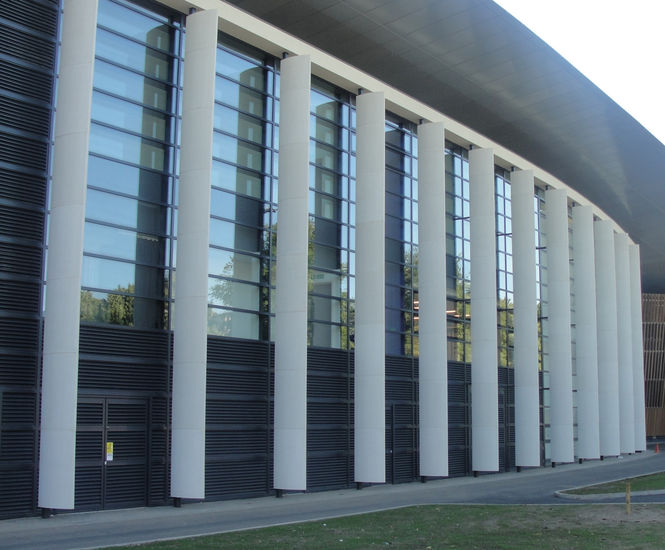
Glassfibre reinforced concrete (GRC) cladding offers several advantages over cast concrete.
- Environmentally friendly
- Lightweight and easy to handle
- Fast to erect
- Reduces loadings on buildings leading to significant savings in superstructure and foundation
GRC can be moulded to form modern futuristic designs or to replicate traditional historic features.
GRC cladding is ideal for renovation projects. The thin lightweight panels are easy to fix and minimise the weight imposed on the existing structure. They can improve both the aesthetics of the building and the thermal and acoustic properties.
Finishes
Can be finished painted, faced with fine aggregate, coloured or left with a natural white or grey, smooth or textured finish.
Manufacturing techniques
One of the most versatile techniques is to cast the composite in moulds manufactured from rubber, timber or glassfibre reinforced plastic (GRP/FRP). This is known as premix GRC.
As the high-performance alkali-resistant glass fibres are evenly distributed in the mix, the material is reinforced throughout, enabling products with the finest of detail to be created. GRC does not suffer from corrosion of the reinforcement and unlike traditional concrete, GRC does not require a minimum of concrete cover to the reinforcement.
The strength of GRC is sufficient so that, even thin skin construction, small modular buildings can be designed without heavy structural frames. GRC walls can incorporate thermal insulation, and the absence of steel reinforcement can be a benefit in electrical or telecommunications applications.
BCM GRC has been making glass reinforced concrete for over 25 years. As a member of the GRCA Approved Manufactures Scheme, BCM GRC offers quality assured products made to the highest grade 18 standard.