

- Sector
- Culture and heritage
- Project type
- New build
- Services provided
- Design
- Year completed
- 2011
- Project location
- Scotland
- Client
- Glasgow City Council
- Consultant
- Zaha Hadid Architects
- Contractor
- Buro Happold
Challenge
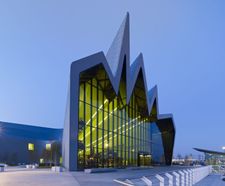
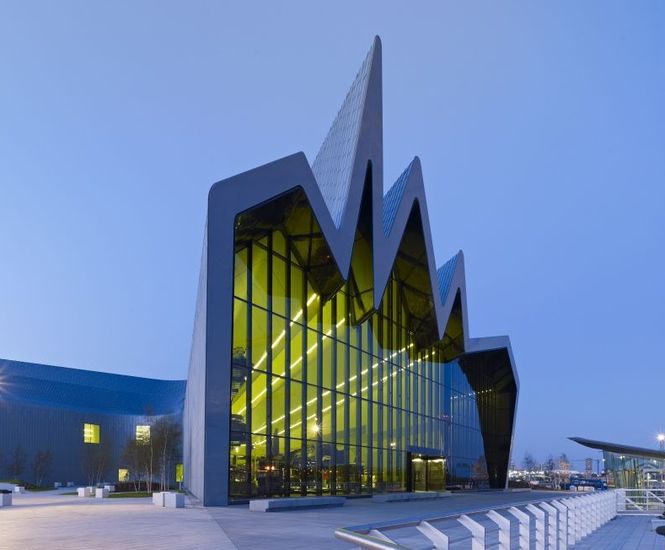
Glasgow's Riverside Museum is the new home for the Glasgow Museum of Transport. The building is characterised by its softly curved, eye-catching architecture and flowing shapes clad in titanium zinc. Its design and construction put unusually high demands on planners and craftsmen alike.
The museum reflects Glasgow's long tradition as a transportation hub. Previously housed in a former tram depot, many of the 3000 exhibits could not be shown, which led to the decision to build a new home for the Transport Museum directly beside the River Clyde.
The contract for designing and planning the new building was awarded to Pritzker prizewinner Zaha Hadid. She has designed an idiosyncratic building that has fast become a visitor attraction. Externally, the building resembles an irregularly folded napkin, bent twice between two fully glazed gable walls. A folded plate of steel, spanning 167m long and 35m wide, is given stability by the two meandering bends in the middle of the structure.
Just as traffic flows on the roads and river through Glasgow, the various exhibition areas flow into and over one another, driving visitors in an easy flow through the museum.
Solution
To achieve the desired appearance, the facade and roof cladding had to possess the same uniform, flowing characteristics. Onto the steel structure, corrugated steel sheets, mineral wool, woodbased panels and bitumen sheets were fitted.
The walls and roof were then clad in 0.8mm titanium zinc from Rheinzink, which has an extraordinarily long life and requires no maintenance. The cladding is further enhanced by the patina that develops through natural weathering and reliably protects the material from corrosion.
Technical Specifications
Roof: 16,000 m² 160 t Double Standing Seam
RHEINZINK-prePATINA blue-grey
Facade: 4,000 m² 40 t Angled Standing Seam System
RHEINZINK-prePATINA blue-grey