

- Sector
- Culture and heritage
- Project type
- Refurbishment
- Services provided
- Product / system manufacture
- Product / system supply
- Project location
- Outside the UK
- Products used
- RHEINZINK titanium zinc cladding with a prePATINA blue-grey surface
A sustainable material to take into the future
RHEINZINK-clad buildings are situated all over the world due to the material's expression, sustainability, durability and maintenance-free surfaces.
RHEINZINK has been certified according to cradle-to-cradle criteria since 2009. This means that all material – including the waste material – can be used in the production of a new product, which is of the same good quality (upcycling).
Another sustainable aspect is directly reusing a material which has had a life elsewhere. Reusing is a huge sustainable theme due to environmental aspects, but also as an obvious cost saver.
A great example of directly reusing is a demounted RHEINZINK façade-cladding on a museum in Finland which was brought to life again on projects in Finland and Sweden.
A façade material to directly reuse
Museum of Contemporary Art Kiasma in Helsinki, Finland, was designed by Steven Holl and realised in the late 1990s.
An internal renovation to make the building more energy effective also resulted in adaptions of the envelope’s substructure, resulting in the external cladding needing to be removed.
This was a golden opportunity to reuse the RHEINZINK titanium zinc with a prePATINA blue-grey surface for a new life on other buildings.
Project 1
• Onsala Space Observatory, Sweden
The observatory provides scientists with equipment to study the earth and the rest of the Universe and operates two radio telescopes in Onsala, 45km south of Gothenburg, and takes part in several international projects.
Parts of the observatory’s new visitor building is now clad with 300m2 RHEINZINK prePATINA blue-grey, reused directly from Kiasma in Finland, and mounted with double standing seam.
A few m2 of the reused RHEINZINK is still available at the Swedish company Återbruksbyrån – a specialist in the reuse of building material. The plan is to use it for a project in Gothenburg.
Projects 2 and 3
In Helsinki, HSY – a company providing waste management services for residential properties and the public administration – will reuse the RHEINZINK material from Kiasma for two of its buildings.
• HSY Koivukylä
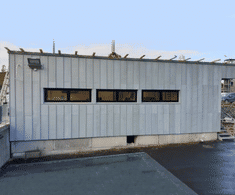
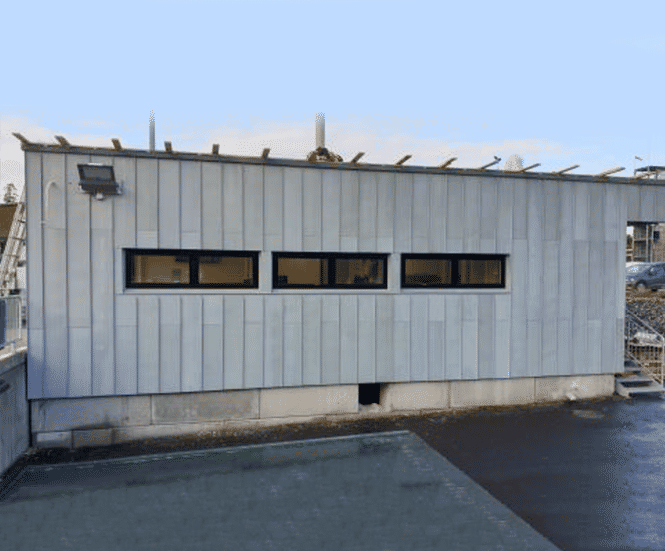
The waste and recycling building has been mounted with approximately 200m2 of reused RHEINZINK on the facade with angled, standing seam.
• HSY Kiviko
This HSY waste and recycling building was also mounted with reused RHEINZINK material in 2023.
For this project Finnish company TPE produced and installed 700-800m2 square tiles.
When the material arrived at TPE, the metal sheet edges were lightly cleaned with compressed air and the folds cut off. Afterwards, the metal sheets started their transformation of being cut into tiles. The tiles were individually bent and fastening parts made, then the tiles were ready for mounting.
The first mock-up was made with a fishscale structure. Another version of the mock-up wall was made later, reflecting the requested changes.
Zinc left over from the cutting work was recycled and some of it used on the construction site.
About Museum of Contemporary Art Kiasma, Helsinki
Kiasma was built in 1998 and was not listed according to the law of heritage buildings - but is actually managed after the same principles.
In the beginning of the year 2000, the first steps were taken by The Senate Properties to list buildings which were not listed officially – to secure important architecture and to take responsibility for the environment.
Kiasma even fulfilled one more aspect: social sustainability, as it is centrally situated in Helsinki – the Finnish capital – close to many users of the Museum.
The Senate Properties - a Finish state-owned enterprise, and the work environment partner of the Finnish government - was behind the entire process, as Kiasma is “voluntarily protected”.
According to Construction Manager Selja Flink, the RHEINZINK material for the façade was mandatory as it was the original material and as they wanted to respect the original Steven Holl architecture; “It is also a unique material because you don’t need to paint it like normal galvanized roofs. And we knew that it had lasted more than 20 years with no problem”, says Selja Flink.
The old sheets were demounted from the façade very slowly by cutting the seams, and afterwards stored carefully. Naturally, this was a costly and time-consuming process including a lot of handwork and transporting.
For the new titanium zinc roof - mounted with double standing seam - special expertise was needed for the many details.
Kiasma is designed by Steven Holl, and his vision for the building concerned choice of material and building details. According to Steve, he designed “the Kiasma route” rather than individual rooms. He simply designed the building for the Finnish people, in their capital – exactly where it is situated.
Comments
Commenting on the fact that the old façade material has been reused for other projects Construction Manager Selja Flink said:
“First of all, I want to tell, that the old RHEINZINK material was still OK after more than 20 years, there was nothing wrong with it, but to be able to adjust structures and underlaying layers, it had to be removed. I have been proud that we could reuse the material. The original idea came from Kari Koskinen from RHEINZINK, who mentioned the Gothenburg project. They could not take all the material, so I started to talk about reuse in every opportunity and finally we found this HSY company who bought the rest of the zinc sheets."
Kiasma has not been renovated the normal way, as the plans and solutions has evolved along with the renovation work. “It was very interesting to renovate such a young building with restoration/conservation attitude. I normally work with really historical buildings, like my next project is restoration of House of Estates from 1890s'. But the same principles can be attended as well.”