

- Sector
- Housing, private
- Project type
- Refurbishment
- Year completed
- 2023
- Contractor
- Cannon Clarke Ltd
- Products used
- Koster Polysil TG 500
- Koster NB
- Koster Repair Mortar Plus
- Koster SB Bonding
- Koster NB Elastic
- Koster Fibre Glass mesh
Challenge
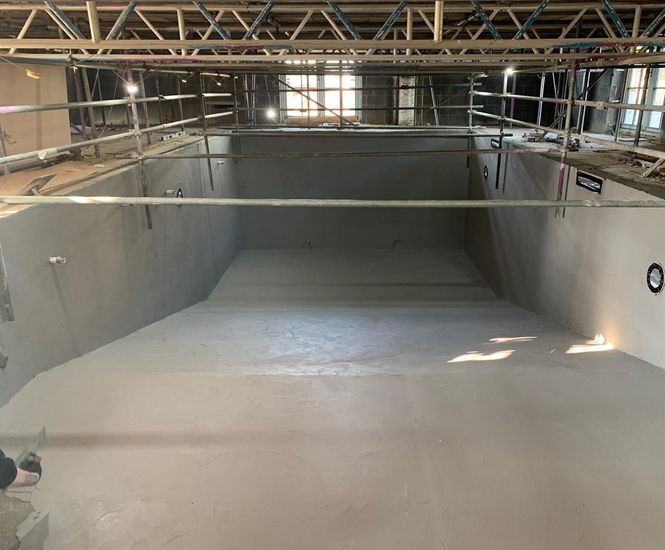
Delta registered installer Cannon Clarke Ltd was approached by the main contractor to assist with specifying and installation of suitable waterproofing solution for a pre-formed concrete swimming pool for a residential development.
The main contractor had previously used a render system for waterproofing swimming pools, but on this occasion couldn’t because of thickness issues. The solution was required to be “flat and true”. The render system previously used would have surpassed the allowed thickness which would have impacted on the tiling process. Tiles are typically installed in swimming pools onto renders and screeds.
Swimming pools can be waterproofed from both the “positive side” and “negative side”. The inside of a swimming pool is known as the ‘negative’ side and the external is known as the ‘positive’ side.
Swimming pools by nature are designed to hold / contain water. One of the challenges faced when designing a suitable waterproofing system for a swimming pool, is ensuring the structure remains watertight (designed to BS EN1992 ‘Water retaining structures’). Swimming pools are often subject to movement, expansion and contraction. This is a common occurrence due to emptying and refilling of the swimming pool which can affect the equilibrium.
Swimming pools can be sunk into the ground or built above, as freestanding construction or as part of a structure. Whilst swimming pool design and construction methods vary, typically they rely on a similar plumbing and filtering system.
Solution
The swimming pool was pre-formed, so a “negative side” waterproofing approach was required.
After attending site meetings, Jamie Prewett, Cannon Clarke’s Technical Manager CSSW, suggested a combined system that would accommodate all of the typical challenges faced when waterproofing swimming pools. The completed system would provide a long-lasting solution.
As with any waterproofing design, attention to detail and substrate preparation is critical.
Substrate preparation of new concrete is quite simple but very important. After a clean and jetwash, Cannon Clarke filled any imperfections in the concrete with Koster Repair Mortar Plus. An application of Koster Polysil TG 500 (anti-lime coating) was utilised to stop lime and salts leaching. Koster Polysil TG 500 has a very simple application, sprayed directly onto substrates.
This was followed by an application of NB 1 crystalline slurry. Koster NB 1 Grey Crystallizing mineral waterproofing slurry can seal against pressurised water (> 13 bar). Koster NB 1 contains crystallising and capillary-plugging agents, so a great solution or swimming pool waterproofing. It can be used for waterproofing against ground moisture and for non-pressurised and pressurised water.
Following the cure of NB 1, an application of Koster NB Elastic was incorporated. This is a great water proofer for “negative side” waterproofing against pressurised water. Curved or coved fillets and fibre glass reinforcing mesh to increase crack bridging were installed to all construction joints prior to the second application of NB Elastic.
Products
Koster Polysil TG 500
Koster NB1
Koster Repair Mortar Plus
Koster SB Bonding
Koster NB Elastic
Koster Fibre Glass mesh
Result
The main contractor had never seen or heard of the Koster system, so was delighted when Cannon Clarke could specify and install a solution that would leave enough space for tiling. They have also been awarded another project.