There are three main objectives for the use of resin injection technology: water sealing, structural repair, and / or soil stabilisation.
In this article "water sealing" is used as a general term to include crack repair, joint repair with local curtain injection, and the use of injection hoses. Cracks in structures typically occur from stresses imposed from the ground surrounding it, whether that be as a result of loading, expansion, ground movement or shrinkage.
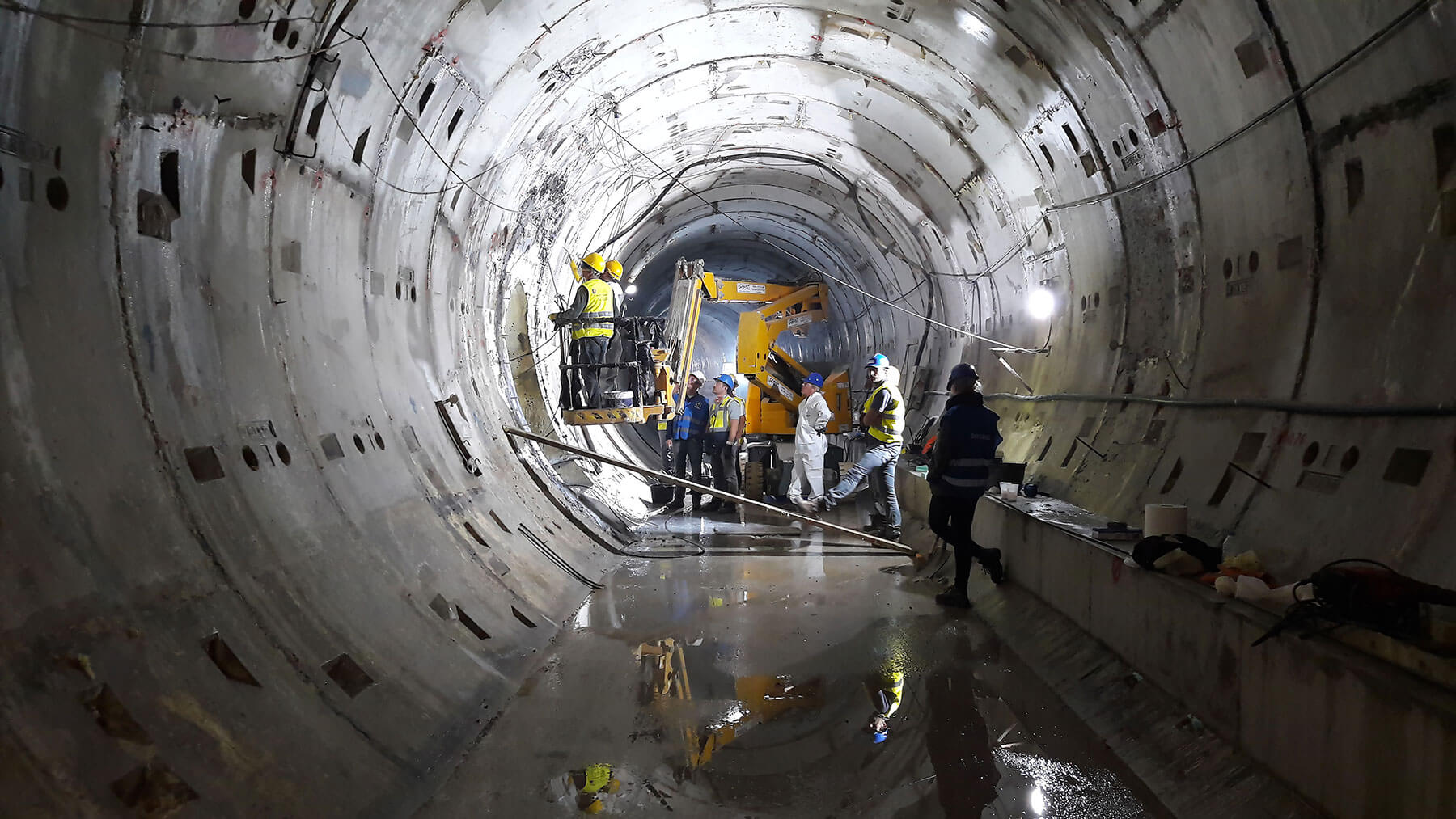
When water sealing, resin injection in:
Basements
Underground car parks
Tunnels
Bridges
Public buildings
Water treatment facilities
Construction sites
Three types of resins
There are three main types of resins:
Polyurethane (PU) resins
Acrylic resins
Epoxy resins
Polyurethane resins are used for temporary water sealing and react quickly in contact with water to stop the flow by foaming and expanding within the given space.
Acrylic resins are used for water sealing via injection hose systems, to permanently seal fine cracks and joints in concrete structures.
Epoxy resins are used for repairing dry cracks in structures where there is no water flow, as the resin forms a rigid seal once it is cured.
Water sealing – crack repair
There are several scenarios in which the correct application of the relevant TRADECC injection resins can provide a solution for sealing the structure against water.
Scenario 1 – A structure facing high water pressure
A damaged structure facing high water pressure will have cracks that permit water to penetrate. The best solution would therefore include a PU resin with a high foaming factor, such as PC Leakinject UNI 6816 E, or PC Leakinject 2K FLEX 6812 LV.
Scenario 2 – A structure facing low water pressure
If structural cracks are faced with unpressurised water, they can be permanently sealed against water ingress using an acrylic resin such as PC 509 Z Acryl, or temporarily sealed using a PU resin such as PC Leakinject 2K FLEX 6811 LV, or PC Leakinject Hydrogel 6880.
For a structure with wet cracks that are facing medium water pressure, we would recommend PC Leakinject FLEX 6870, which is a single-component, low viscosity polyurethane resin that reacts with water to create a flexible foam, expanding up to 800% of its original mass.
Scenario 3 – Water sealing and joint repair
TRADECC’s PC 509 Rubber Acryl or PC Leakinject FLEX 6890 are the best resins for sealing and repairing structural joints against water. PC Leakinject FLEX 6890 is good for temporary joint repair, due to its flexibility, whilst PC 509 Rubber Acryl is the best option when permanent joint sealing is necessary.
Scenario 4 – Injection hose systems
When a waterproofing project requires an injection hose system to waterproof the construction joints, the hose is pre-installed before the concrete is poured. Afterwards, if leakage occurs through the concrete, resins can be injected into the structure to fill any cracks and imperfections.
Scenario 5 – Structural repair and crack injection
As previously mentioned, epoxy resins form a rigid seal, making them ideal for repairing dry cracks in concrete. Epoxy resins also have a long shelf life and provide an easy, one-step injection process.
Summary
In summary, for crack repairs where there are high levels of water ingress, a polyurethane resin such as PC Leakinject UNI 6816 E or FLEX 6870 provides the ideal solution. In contrast, a crack repair project where there is high humidity could be resolved with either PC Leakinject 2K FLEX 6811 LV, or an acrylic resin such as PC 509 Z Acryl.
Similarly, joint repairs can be resolved with either the acrylic PC 509 Rubber Acryl or the PU PC Leakinject FLEX 6890. If an injection hose system is required, then the best resin to utilise would be the acrylic PC 509 ZL Acryl. In general, acrylic resins will provide a more permanent water sealing than polyurethane resin.
However, if a structural repair is required to dry concrete, an epoxy resin such as PC Structo Inject 1380 is best suited.
Please be aware that the scenarios above are ultimately a theoretical explanation of the injection technology that is available for water sealing and concrete repair. In practice, the decision of which resin to choose will depend on the unique scenario present at each individual project, which will undoubtedly have various circumstances that will need to be considered.