The difference between a cavity fire barrier and a fire-stop
What's the difference between a cavity fire barrier and a fire-stop?
Cavity fire barriers and fire-stops are two types of passive fire protection that can slow or stop the spread of flames and smoke in a fire situation. But what is the difference between them?
These two phrases are sometimes used interchangeably. For example, the NHBC recommendations for pitched roofs refer to fire-stops and cavity barriers as fire-stopping measures. Indeed, both product types can stop or slow the spread of fire and smoke; however, if you’re looking to distinguish between the two terms:
- A cavity fire barrier fills concealed internal gaps within walls, ceilings and other parts of a building.
- Fire-stops typically fill visible gaps around openings or joints in fire-resistance rated walls.
Now, let’s look at cavity barriers and fire-stops in more detail.
What is a cavity fire barrier?
Approved Document B of the Building Regulations defines a cavity barrier as a construction, other than a smoke curtain, which:
- closes a concealed space against penetration of smoke or flame; or
- restricts the movement of smoke or flame within such a space.
These barriers are used to form a complete seal between different areas of a home. Without them, experts say that fires can spread five to ten times faster through a building.
What is a fire-stop?
Fire-stops create a seal around openings and between joints, helping to maintain the fireproofing of a wall or floor assembly and preventing the spread of fire and smoke.
The Structural Timber Association (STA) explains that fire-stops close a gap or imperfection in a fire-resisting element of a structure or compartment lining. They should have at least the same fire resistance as the function requirement in which they are located.
In addition, the STA says that fire-stops can achieve cavity barrier functions if they are used to close a cavity. However, a cavity barrier is not considered a fire-stop unless it is designed for that function.
Preventing the spread of fire in roofs
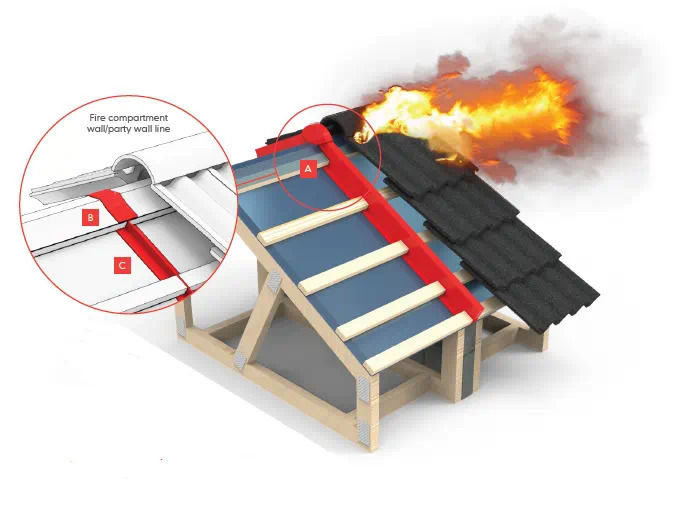
Cavity barriers and fire-stops are critical elements in preventing the spread of smoke and fire, especially in the compartmentation of multi-occupancy buildings, such as terraced homes, semi-detached houses and blocks of flats. These products are often suitably specified within the liveable areas of a building, but fire protection often falls short when it comes to the roof.
In recent years, there have been several cases of fires spreading between homes in multi-occupancy buildings due to inadequate cavity barriers and fire-stops in the roof. In many of these cases, the party walls between properties had adequate protection between the lower levels; but that protection did not extend into the roof void, allowing fire and smoke to travel easily between properties.
Extending the cavity fire barriers and fire-stops through the entire height of the house, including the roof void and roof construction, is essential for preventing the spread of fire and smoke between adjoining properties.