An amendment was made to Approved Document B of the building regulations that came into force on 21st December 2018. The amendment banned the use of all combustible materials on the external face of buildings over 18m tall. To be compliant, materials have to achieve a fire classification of A2-s1 or A1 classified in accordance with BS EN 13501-1:2007+A1:2009.
A number of items have been excluded from the ban, including window frames and glass. Surprisingly, however, these exclusions do not appear to extend as far as including glass in balustrades which are often in the same location on a balcony.
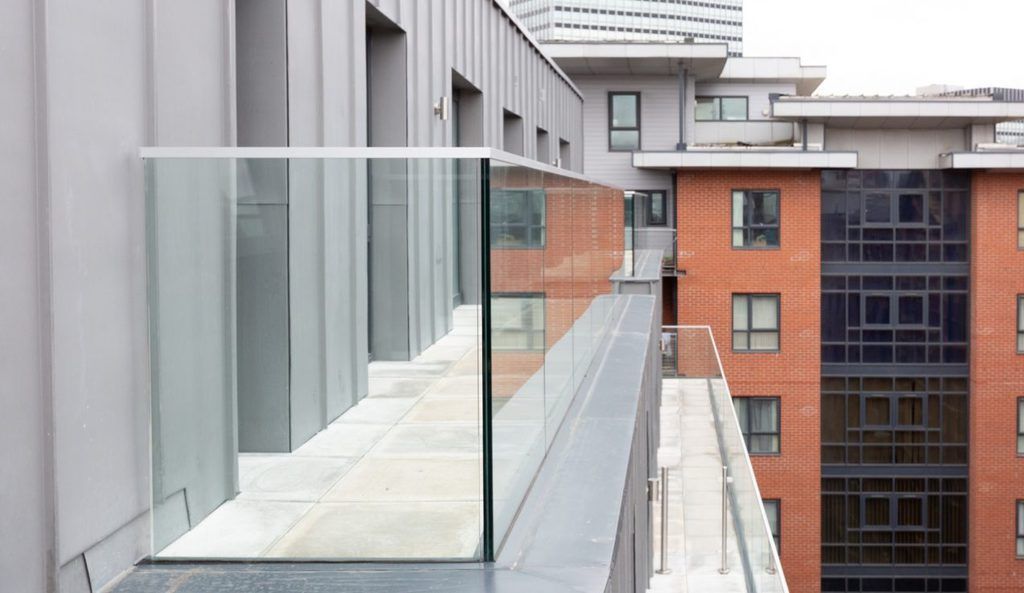
Balustrade with glass from BA Systems
Glass in balustrades protecting a drop from height has to be laminated with a PVB or SGP interlayer for the product to be adequate for the purpose for which is intended, that is to protect the edge from falls. Even toughened glass, although extremely resistant to impact, can still break for a number of reasons. The laminated interlayer remains in place and has the effect of holding the broken glass in place whilst still providing some protection to the balcony edge.
It is highly unlikely that both panels of glass will break at the same time so in the case of breakage, the edge remains safe. Monolithic glass, will break, as toughened glass does, and will most likely disappear, falling in large chunks that could cause harm if falling from height. The opening then remains unprotected until the balustrade can be replaced.
The ban on toughened and laminated glass has come into effect because of the PVB interlayer in the glass, which as a stand-alone product, does not meet the fire classification requirements. However, this ban does not consider the laminated panel as a complete product. A study of the nature of laminated glass and the way it is manufactured, shows that it is impossible for the laminate to ignite. Even simple tests prove this. The laminate is encapsulated in the glass under high pressure and the bottom and top edges are wholly contained within the base channel and top capping rail or handrail. It is only the 1.5mm thick edges that are exposed on the sides of the panels, and chances of the laminate igniting and fire spreading on this small area is extremely low.
The reasons behind the ban are fully understandable, but decisions of this magnitude need to be made with a holistic view of the product used on balconies and drawn from knowledge and experience of the market rather than a basic understanding of standalone materials.
Regulations aside, our view is that the risk of monolithic glass on balconies at height pose a much greater risk than the use of so-called flammable PVB interlayers in the glass.
Is this laminated glass debate a current issue on one of your projects?
BA Systems can provide further test data and technical expertise to assist in making decisions on the chosen glass specification.