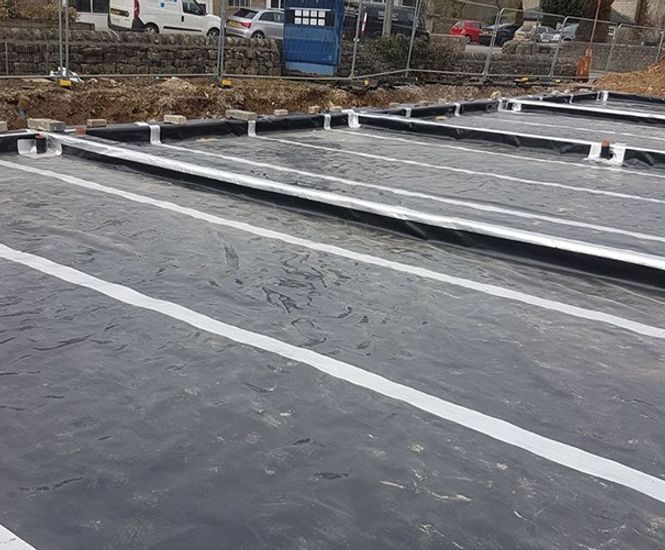

There are many complexities and challenges on structural waterproofing projects which also require ground gas protection.
Projects which need both a waterproof and gas proof protection system require a different strategy and methodology from what would be classed as a typical waterproofing design. Both BS8102:2009
and BS8485:20015 are intertwined. Basements and below ground structures needing to be watertight and gas proof require further considerations at the design phase and throughout the project.
The object of structural waterproofing is to protect a structure for its lifetime from water ingress.
The object of ground gas protection is to prevent a build-up of gases against a structure.
A Waterproofing Design Specialist will be able to interpret the requirements of BS8102:2009 and BS8485:2015 to produce a waterproofing design which incorporates both a waterproof and gas proof protection system.
If a site has been identified with a gas or hydrocarbon contamination it will have been given a Characteristic Situation Score. The Characteristic Situation Score is defined according to how severe the gas flow from the ground is. All sites which have been characterised with a gas situation score will require a gas protection system and where identified a waterproof protection barrier.
Methods of gas protection
Gas protection is a technical solution to prevent or to control gas penetration into properties. The control of gas migration is normally achieved by blocking the pathway or removing the source of the gas generation. There are several methods available to achieve the protection to existing/new build
properties.
Gas protection measures available to achieve the minimum points score requires a combination of two or more of the following protection measures be used:
- The Structural Barrier
- Ventilation Measures
- Gas Resistant Membrane
Method of structural waterproofing
There are 3 Types of waterproofing methods. These are defined as:
Type A Tanked or Barrier Protection. Cementitious or bitumen-based products applied internally, externally or sandwiched within the structure.
Type B Structurally Integral Protection. Reinforced or prestressed concrete designed through composite and integrated details such as water bars to be water resistant.
Type C Drained Protection. Cavity Drainage Systems which allow for water ingress but in a controlled fashion
Evaluation of groundwater conditions, risk assessment and options for drainage outside the structure should always be considered.
Dangerous ground gases include:
- Hydrocarbons
- Methane
- Carbon Dioxide
- Radon
- Volatile Organic Compounds (VOCs)
Structural Warranty Provider requirements
Many Structural Warranty Providers now mandate that a CSSW qualified Waterproofing Designer is involved in the waterproofing design process.
To find a waterproofing design specialist, the Property Care Association has devised a Register which allows developers, architects, builders etc to quickly locate vetted and approved Waterproofing Design Specialists who can assist in the design and planning of underground waterproofing.
A Waterproofing Design Specialist will work with architects, surveyors, contractors and engineers alike to provide a design service which complies with BS8102:2009 and BS8485:2015 and offers detail to design. The ability to easily identify and engage a Waterproofing Design Specialist will allow a design team to conform to the recommendation set out in BS8102:2009 and BS8485:2015.