

- Sector
- Housing, private
- Project type
- New build
- Year completed
- began 2008, completed 2013
- Project location
- South East England
- Contract value (£)
- The aircrete value was £312,000
- Client
- Linden Homes
- Consultant
- Terence O’Rourke Ltd
- Contractor
- Galliford Try Partnerships Ltd (main contractor); Hart Construction (specialist aircrete contractor)
- Products used
- Rå Build method of aircrete construction with H+H blockwork and Celfix thin joint mortar
Challenge
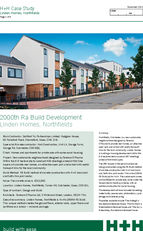
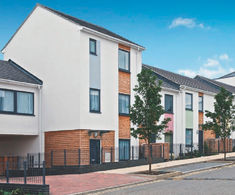
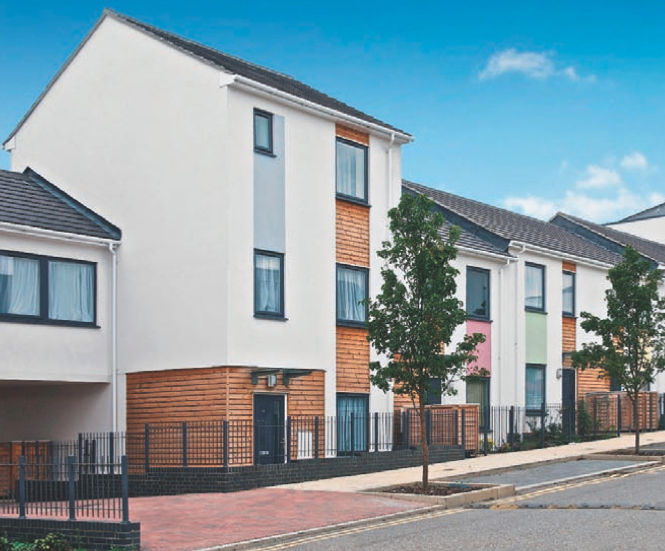
Northfields, Colchester, is a new sustainable neighbourhood designed by Terence O’Rourke to provide new homes, an attractive open park and school with useful transport links for the local community. This development is the 2000th Rå Build job for H+H.
Linden Homes is building a housing development within this 6.9 hectare site to construct 367 dwellings aimed at first-time buyers. The 266 houses in the second phase are being constructed using the Rå Build method of aircrete construction with H+H blockwork and Celfix thin joint mortar. The sustainable homes will be offered for private sale, some under the Government’s NewBuy scheme, with an additional allocation for social housing. The development will have rainwater harvesting (water butts), passive solar, photovoltaics, cycle storage and waste recycling.
Originally, the build method was timber frame, however Linden Homes saw a potential cost-saving of up to 10% by switching to the Rå Build method of thin-joint aircrete construction. Terence O’Rourke recognised that an aircrete solid wall construction method meant a more robust build that would support the varied external cladding types used.
Solution
The Rå Build method uses the fast-setting thin-joint system with large-format blocks to build the inner aircrete leaf directly to full storey heights – with intermediate floors and roof installed – ahead of the external brickwork or cladding. This provides a fast, stable and weatherproof shell, allowing first-fix trades early access while the external cladding is completed. Further time is saved by the use of retrofitted joist hangers, avoiding any block cutting at floor level, and enhancing air permeability levels.
The external solid walls were built using 3.6N and 7.3N/mm2, 200mm thick Plus Blocks, insulated using 150mm EPS insulation with a Weber Therm XT render system. Separating walls were constructed with two leaves of 100mm Jumbo Bloks (Robust Detail E-WM-10).
The general sales properties needed to be built to Eco Homes ‘excellent’ standard, and the affordable units are being constructed to Level 3 of the Code for Sustainable Homes. It was essential that a product was chosen that could meet these standards, whilst also being cost-effective and robust.
The initial construction phase used a timber-frame method, however as the project developed, further consultation proved that a more robust, cost- and time-effective method would be required to suit the brief and the changed market conditions.
H+H was chosen as they perfectly met the specification by providing a sustainable and robust build method that would save in excess of 10% compared to timber frame.
U-value target:
- Walls featuring 200mm 3.6N Standard Grade Plus Blocks: 0.15 W/m2K.
- Ground Floors: Between 0.17 and 0.23W/m2K.
- Roof: 0.14 W/m2K Doors / Windows: 1.50 / 1.30W/m2K.
Thermal bridging:
- Y-value: 0.08W/m Accredited Construction Details.
Outcome
“From a design perspective, the solid aircrete walls meant there were no restrictions for positioning studwork and other fixings, and it also provided an excellent substrate for the variety of cladding types and insulated render systems used on the project.”
Dan Fairley, Senior Architect Terence O’Rourke
“Linden Homes was frustrated with timber-frame, and it was decided that we should use a faster, more robust method and one that was more cost effective. By switching to Rå Build we were able to save in excess of 10%, as we can get the inner shell of a masonry home built very quickly.
We have worked with H+H for over 13 years and we are always impressed with the results that can be achieved with their product. The work being carried out at Linden Homes, Northfields, has only confirmed my high opinion of the company.”
Craig Hart, MD of Hart Construction
“H+H is particularly proud to be involved with this project as it’s the company’s 2000th Rå build job, demonstrating the popularity of the method. Unlike most frame systems, the Rå Build method of construction does not require any waiting time for settlement before applying the render or other finishes. In fact, the first-fix trades can start work inside whilst the external skin is going up – therefore saving valuable time and money.”
Graham Keenor, H+H Development Manager