The key to successfully waterproofing a basement conversion is to choose a system that will achieve the degree of waterproofing required for the intended use of the basement.
If the basement conversion is going to be used for habitable accommodation it needs to be totally dry with no water or water vapour.
You have two choices:
- Attempt to hold water back by applying a cementitious system to the basement (barrier option).
- Install a cavity drain system, which will manage and expel any water ingress prior to damaging internal finishes (cavity drain option).
A. Barrier option
This barrier will require preparation by a trained waterproofing expert. To make it 100% watertight means 100% workmanship, which can be difficult to achieve.
In all circumstances, for an internal barrier to be effective you will need to do not only the walls but also the floors. Make sure you have a good existing slab here, or even a new one, to make it effective.
Advantages
The biggest advantage with the barrier is that – if placed perfectly – it will negate the need for installing any form of sump system, which saves on future maintenance costs.
Disadvantages
- Any applied system will need preparation to the substrate prior to application, which can prove very disruptive and messy. Depending upon the substrate, you may have to rake out the mortar joints, sand blast, scabble, and hack off to get back to the substrate and prepare it ready for the applied barrier.
- Wet trades are involved, and you are potentially making a wet project even more damp by introducing a wet solution. This can lead to problems with the waterproof barrier in terms of drying times. Drying-out times are one of the most frustrating elements of the barrier approach: this can significantly impede a building programme, especially when it comes to being able to decorate the finished project.
- Inability to fix things like shelving units into the barrier without puncturing the barrier. This will also invalidate any guarantee that was offered by a professional installer.
B. Cavity drain option
For the majority of projects, cavity drains provide a better solution.
To waterproof an existing basement you use a series of dimpled sheet membranes (usually 8mm in depth) which are mechanically fixed back to the building fabric using a waterproof MultiPlug (plug with a waterproof seal which acts like a rawl plug that you can fix into).
Then depending upon the finish required either a plain 8mm membrane with battens on plugs or a frame work tied back into the plugs or a meshed dimpled sheet which you can render onto.
These systems act as a water management system in your existing basement, moving any moisture or water behind the dimples and down to an internal drain, which is installed at the wall/floor junction.
The drain can then either feed out to an open elevation or an existing drain, or a sump and pump.
Advantages
The drained cavity has many advantages:
- Minimal surface preparation required, if any.
- Can be installed with no wet trades or drying-out times.
- Can be decorated quickly if an independent dry-lining frame is used.
- Does not push water to other areas of the project – as could happen with a barrier.
- Can be used on all listed buildings as it is fully reversible – barriers are not.
- Newton System 500 is maintainable – a requirement of BS8102:2009.
- The integrity of the system is not dependent on 100% defect-free workmanship, unlike conventional tanking.
Disadvantages
- The biggest disadvantage is that if you are below invert level you will need to use a pump, which will mean ongoing maintenance.
Advantages of Newton System 500 cavity drain waterproofing
Unlike conventional tanking/barrier waterproofing, Newton System 500 places designed maintainable depressurization voids at known weaknesses in the structure, so that problem water is simply captured and diverted out of the property. It is recognized by the British Standard and industry experts as the “least likely system to fail”. Newton System 500 comprises wall and floor cavity drain membranes, a drainage system and a sump pump. The system can be installed in all weather conditions, and is easily repairable should the membrane be damaged by other trades.
Installation and approved contractors
The most important thing is to make sure that whichever system you use, you need to get a professional waterproofing contractor to undertake the works. Newton Specialist Basement Contractors (NSBC) are an elite group of professional waterproofing contractors who work in partnership with John Newton & Company to provide the specifier and their clients with the highest quality products, design and installation in all aspects of domestic and commercial waterproofing.
Request a list of registered installers in your area.
Waterproofing an existing basement – download guide
Case study: waterproofing the Boat House, Henley-on-Thames
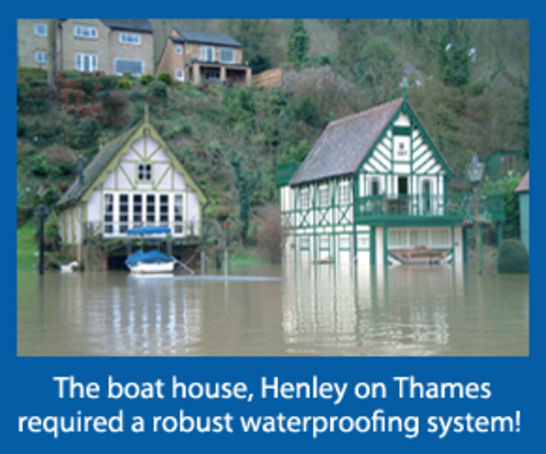
The Boat House in Henley-on-Thames was a truly unique project. The owners got in touch with John Newton & Company following flooding that saw water levels reach up to 500mm internally. Newton System 500 provided the ideal solution for this unique project, as it works by redirecting the water, rather than trying to hold water back – which would be impossible under such pressurised conditions.
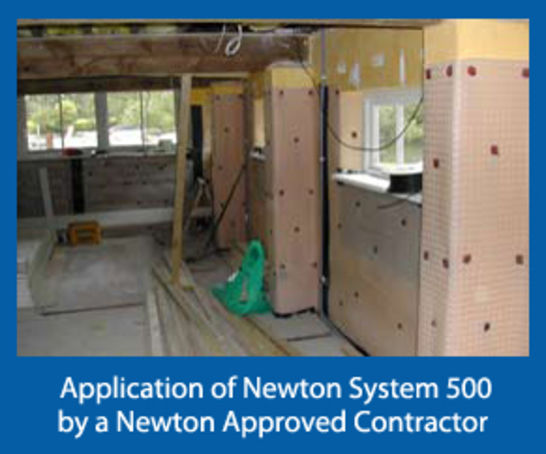
Newton 508 Mesh was chosen for the walls, and Newton 520 for the floor, with a Newton Basedrain ring around the perimeter. Two Newton Titan Plus pump systems were used, which included a battery back-up system. Rather than holding water pressure back, therefore, it was accepted that the river would penetrate the structure and would be pumped out.
The full waterproofing system was installed in little over a week. The major test came when the River Thames rose against the property to a depth of over one metre! The Newton System 500 waterproofing system coped with the water ingress as designed. At the height of the flooding, all three pumps in each sump chamber were operational. The system proved to be completely successful.
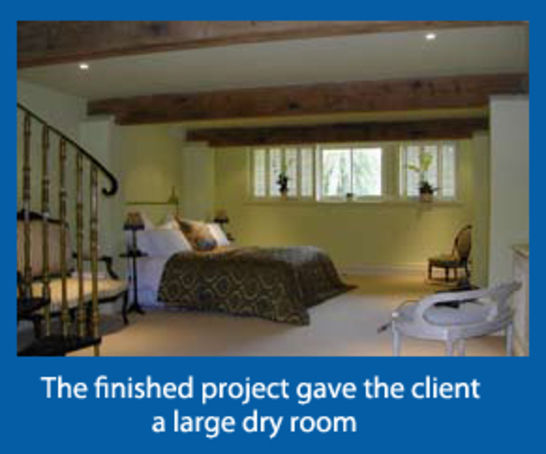
Our client can now happily eat his breakfast in bed, watching the boats float past his window, in the confidence that his property is completely dry!