What is tanking?
Tanking is a generic term used to describe various products that are used to deal with water entering a below-ground building.
Tanking membranes are one of these products. They are applied to the structure, either internally or externally, to physically prevent water ingress. They are a more traditional method of dealing with water from the ground.
Examples of tanking membranes include:
- Bituminous bonded sheet tanking membranes
- Bituminous paint tanking membranes
- Polyurea tanking membranes
- Epoxy coatings
- Cementitious tanking membranes
- Expanding clay sheet tanking membranes
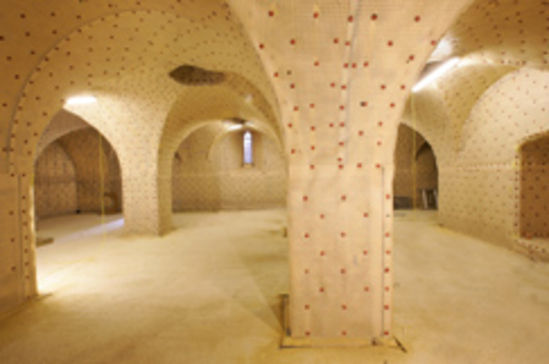
Newton 508 Mesh used to treat damp in the Royal Court of Justice
Limitations: substrate preparation
Tanking membranes will only be effective if they are applied to a well-prepared substrate. This often requires the use of exhaustive and potentially damaging and expensive preparation techniques such as needle gunning, bush hammering, hacking off wall finishes, shot blasting, raking out mortar joints, re-pointing and applying salt neutralising solutions.
Limitations: defect-free application
Once the substrate has been prepared the tanking membranes needs to be applied. This is often where the problem occurs with tanking membranes. By their very nature tanking membranes need to be 100% defect-free because when water is under pressure it follows the path of least resistance, seeking out weak points.
Indeed, in the in high court case Outwing vs Weatherald it was deemed that it is not reasonable to expect a tanking or waterproofing system to be applied 100% defect free.
Limitations: requirements of BS 8102
A properly installed system should meet the requiements of BS 8102 – the code of practice for the protection of structures from water from the ground – which recommends a maintainable waterproofing system.
There are not many designs which include externally applied tanking membranes that are maintainable.
Limitations: land drainage
It is common with externally applied tanking membranes that an external land-drain is introduced to help dewater the surrounding ground area and stem the flow of water that comes to bare against the structure and tanking membranes.
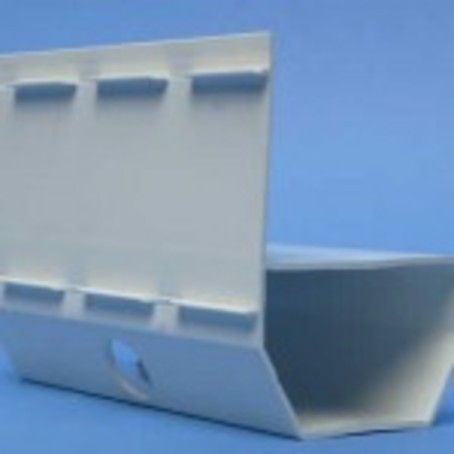
Newton Basedrain
This poses significant problems as it is almost impossible to accurately calculate the volume of water that could present itself in the future and, consequently, it is almost impossible to calculate the size of land drain that is required.
Cavity drain membranes
Cavity drain membrane systems offer a modern, reliable and risk-free alternative to tanking membranes where there is actual or potential water ingress into the structure.
They allow water to penetrate the structure and then divert it through a drainage channel or conduit to a suitable drainage point.
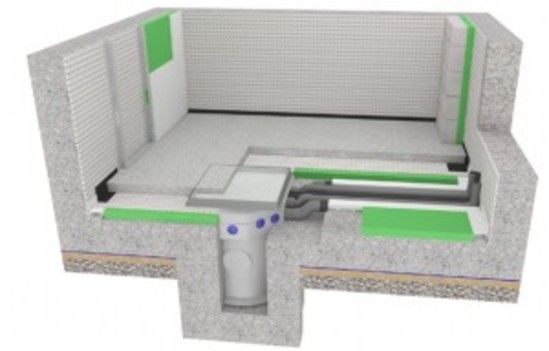
Newton System 500 Cavity Drain membrane basement waterproofing
Cavity drain membrane systems generally accept the following principles:
- Earth against a structure is a conduit and direct route for water in the ground to reach a building.
- If the earth cannot be removed then you must expect that water will come to bare against the structure to the full height of the areas below the ground unless comprehensive geological inspections can prove otherwise.
- Even when the site investigation indicates dry conditions, the risk of some water logging in the future should be assumed.
- Even in a permeable subsoil, ground water requires time to drain away and this can result in limited pressure periodically coming to bear against the structure
- Even when a structure is well built, if it is below the ground you must expect that if water comes to bare against it, it will enter the fabric of the building at some time in its life.
- When water enters a structure all it wants to do is find an air gap and depressurise.
- And cavity drain membrane systems generally offer the following benefits:
- The system depressurises water so it is never subject to aggressive water pressure.
- They are designed so that defects in the membrane will not affect the efficacy of the system. Damage is easily repairable.
- They are maintainable via inspection ports in the drainage conduit and conform to BS 8102.
- They can be tested to assess performance before fixtures, fittings and finishes are applied.
- They are suitable for heritage projects as they are sympathetic to the structure and easily removable.
- They usually require only minimal surface preparation.